
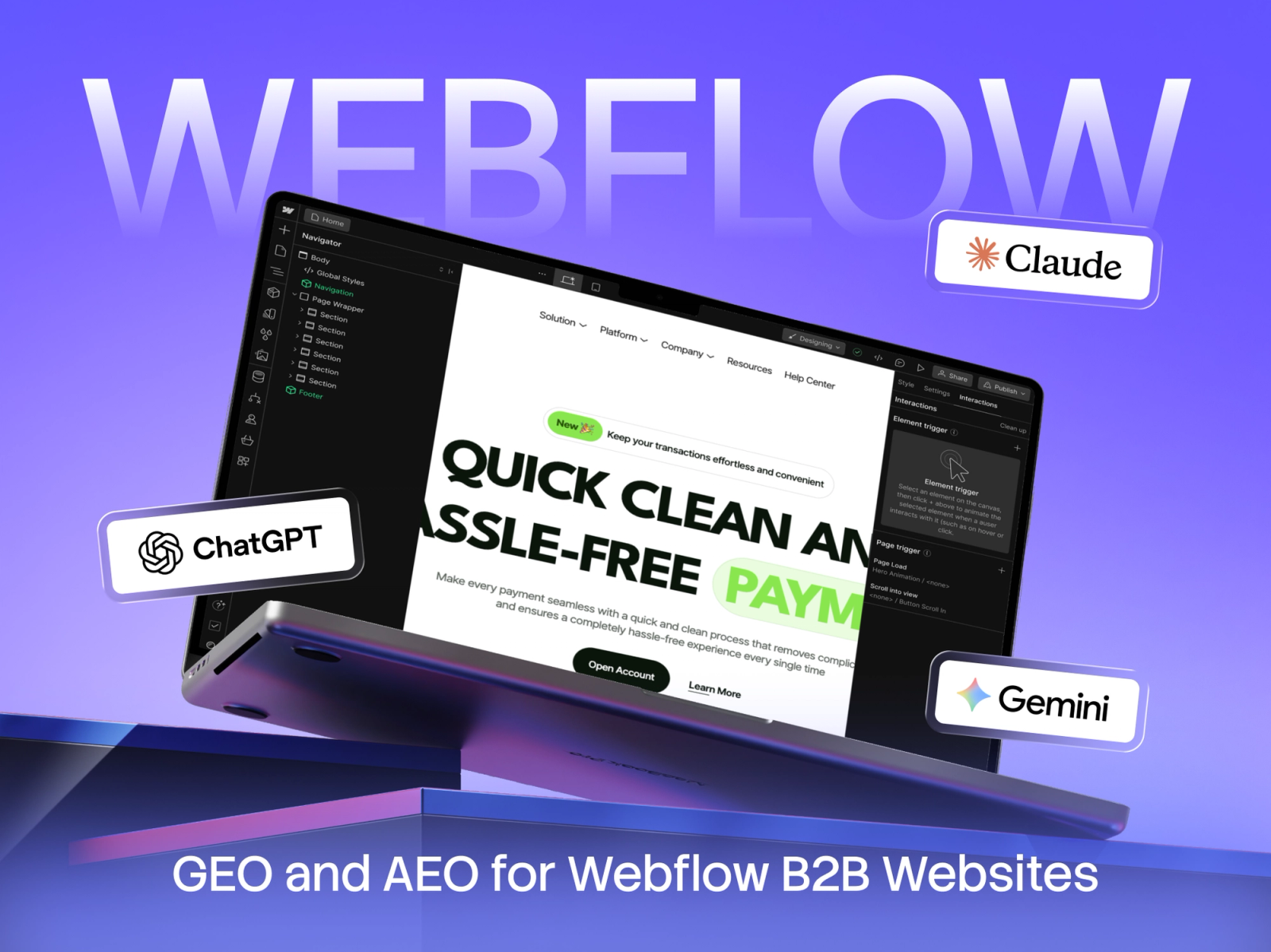
 ChatGPT
 Claude
 Gemini
 Perplexity AI
A B2B marketing leader we work with put it bluntly last quarter: "I don't care if I rank #1 on Google anymore. I care if ChatGPT mentions us when someone asks about our category." Three years ago that sentence would have sounded ridiculous. In 2026 it's a board-level KPI.
If your B2B site runs on Webflow, you're already on one of the most capable platforms for GEO and AEO. But the defaults won't carry you.
The work below is the exact Webflow implementation playbook we run on Windmark builds: which schema goes where, how to structure CMS templates so AI engines can lift quotable passages, how to allow the right AI crawlers in robots.txt, and how to architect a site that wins both the AI citation and the featured snippet at the same time.
GEO vs AEO: quick definitions before we build
A small but important distinction, since the two terms are now used interchangeably and that confuses execution.
- GEO (Generative Engine Optimization) is the practice of structuring your site so generative AI engines (ChatGPT Search, Perplexity, Google AI Overviews, Bing Copilot, Claude, Gemini) quote you as a source inside their synthesised answers. The unit you're optimising for is a citation inside a generated paragraph.
- AEO (Answer Engine Optimization) is the broader bucket that covers being the answer itself: Google featured snippets, "People Also Ask" boxes, voice search results, and the answer card on Bing. The unit you're optimising for is being lifted as the single answer by any engine that produces one.
Both reward the same underlying behaviour. Write content shaped like an answer to a question, mark it up so machines understand the structure, host it on a fast, retrievable site, and earn authority signals around the content.
The tactics overlap by about 80%. The reason to keep the labels distinct is that GEO has a higher ceiling (every category query is up for grabs) and AEO has faster feedback (Google still tells you when you're in a snippet).
On a Webflow B2B site, you implement them as one programme. The remainder of this guide treats them together unless the tactic is specific to one or the other.
Why Webflow is genuinely well-suited (and where it traps teams)
Three reasons Webflow has become a serious GEO/AEO platform in 2026.
Server-rendered HTML by default. AI crawlers (GPTBot, PerplexityBot, ClaudeBot) read HTML, not client-side JavaScript.
Webflow ships pages as fully rendered HTML, which means the model can actually see your content. A site built on a JavaScript-heavy stack (without SSR) is often invisible to these crawlers. A Webflow site is not.
Native schema embed via Custom Code. Webflow lets you drop JSON-LD into the `<head>` of any page or CMS template, and bind those fields to Collection data. This is the single most important GEO/AEO mechanic, and Webflow does it more cleanly than most CMSs we audit.
Fast Core Web Vitals on the Business plan. Webflow's CDN, image optimisation, and responsive images mean a well-built site hits Good Core Web Vitals without fighting the platform. AI engines deprioritise slow sources. Webflow makes "fast" the default.
The trap: nothing is automatic. The marketer who launches a Webflow site without ever opening Project Settings > Custom Code, never sets a single dynamic schema field, and leaves robots.txt at defaults: that team gets none of the upside. The platform is capable. The implementation is on you.
The remainder of this guide is exactly that implementation, end-to-end.
Step 1. Configure robots and crawl access for AI engines
This is the lowest-effort, highest-leverage hour you'll spend. In Webflow Project Settings > SEO > robots.txt, explicitly allow the AI crawlers (or block them deliberately if you have a reason).
For most B2B companies, the default position is allow:
User-agent: GPTBot
Allow: /

User-agent: ChatGPT-User
Allow: /

User-agent: PerplexityBot
Allow: /

User-agent: ClaudeBot
Allow: /

User-agent: anthropic-ai
Allow: /

User-agent: Google-Extended
Allow: /

User-agent: Bingbot
Allow: /

User-agent: *
Allow: /
Disallow: /staging/
Disallow: /admin/

Sitemap: https://yourdomain.com/sitemap.xml
`Google-Extended` is Google's specific user-agent for AI training/Overviews data. Allow it independently from regular Googlebot. `ChatGPT-User` is the at-request crawler ChatGPT uses when a user explicitly clicks a source. `anthropic-ai` is the legacy crawler name. `ClaudeBot` is the new one. Include both for now.
If your business has a reason to opt out (proprietary research, paid research, IP concerns), block deliberately and document the trade-off. For most B2B SaaS, citation visibility is worth far more than any training-data downside.
While you're in Webflow SEO settings: verify your sitemap is auto-generated, all CMS items are included, and the sitemap pings on every publish.
Step 2. Build schema into every Webflow template
Schema is the single biggest GEO/AEO lever inside Webflow. Generative engines and Google's answer systems both rely on structured data to understand what a page is about, who wrote it, when, and what claims it makes.
Without schema, your page is text the model has to interpret. With schema, your page is an explicit data structure the model can quote with confidence.
In Webflow, schema lives in Page Settings > Custom Code > Inside `<head>` tag for static pages, and in Collection Page Template > Custom Code > Inside `<head>` tag for CMS templates. JSON-LD is the format you use.
Below are the five schema types every B2B Webflow site should ship.
Article schema on every blog post template
<script type="application/ld+json">
{
  "@context": "https://schema.org",
  "@type": "Article",
  "headline": "{{ Name }}",
  "description": "{{ Meta Description }}",
  "image": "{{ Main Image }}",
  "datePublished": "{{ Published On }}",
  "dateModified": "{{ Updated On }}",
  "author": {
    "@type": "Person",
    "name": "{{ Author > Name }}",
    "url": "https://yourdomain.com/authors/{{ Author > Slug }}"
  },
  "publisher": {
    "@type": "Organization",
    "name": "Windmark",
    "logo": {
      "@type": "ImageObject",
      "url": "https://yourdomain.com/logo.svg"
    }
  }
}
</script>
The curly-brace tokens are Webflow CMS bindings. In the Custom Code editor, the `+ Add Field` selector inserts them from your Collection.
FAQPage schema on every page with an FAQ block
<script type="application/ld+json">
{
  "@context": "https://schema.org",
  "@type": "FAQPage",
  "mainEntity": [
    {
      "@type": "Question",
      "name": "{{ FAQ Q1 }}",
      "acceptedAnswer": { "@type": "Answer", "text": "{{ FAQ A1 }}" }
    },
    {
      "@type": "Question",
      "name": "{{ FAQ Q2 }}",
      "acceptedAnswer": { "@type": "Answer", "text": "{{ FAQ A2 }}" }
    }
  ]
}
</script>
Bind these to a CMS Collection field per FAQ pair so marketers can edit the questions without touching code. FAQ schema is the highest-impact AEO mechanic in 2026. It's the schema most often pulled into "People Also Ask" and into AI engine citations.
HowTo schema on guides, checklists, and tutorial pages
HowTo schema makes a guide eligible for Google's How-To rich result, and more importantly, signals to generative engines that this content is structured as a sequence of steps. Easy to lift, easy to cite.
Product schema on product, solutions, and pricing pages
Even if you're a SaaS rather than e-commerce, Product schema is appropriate for solutions and pricing pages. It gives engines a clean entity to attach reviews, ratings, and price data to.
Organization schema (global), in Webflow's site-wide Footer Custom Code
<script type="application/ld+json">
{
  "@context": "https://schema.org",
  "@type": "Organization",
  "name": "Windmark",
  "url": "https://yourdomain.com",
  "logo": "https://yourdomain.com/logo.svg",
  "sameAs": [
    "https://linkedin.com/company/windmark",
    "https://twitter.com/windmark",
    "https://github.com/windmark"
  ]
}
</script>
Drop this in Project Settings > Custom Code > Footer Code so it loads on every page. It's the foundation of your brand entity. The model uses it to understand what Windmark is across every page it crawls.
Step 3. Architect the Webflow CMS for answer-shaped content
This is the layer where most B2B Webflow sites quietly cap their GEO/AEO ceiling. They launch with a Blog Collection and a Case Studies Collection, ship 30 posts, and discover 18 months later that there's no way to scale into the answer-shaped page types that AI engines love.
Build these Collections from day one.
Glossary / Library Collection. One CMS item per category term. Each item has a clean definition (50 to 80 words, written as the first sentence the engine will lift), a long-form explanation, related terms, and FAQ schema.
Glossary pages are the single highest-volume citation source for category creators because they answer "what is X?" queries directly.
- Statistics & Research Collection. One CMS item per statistic or dataset. Each has the headline number, the methodology, the source, the year, and a citation block. We've seen single statistics pages on Windmark client sites earn 10+ AI citations in a quarter. They're disproportionately powerful.
- Comparison Pages Collection. One CMS item per "[Your category] vs [Competitor]" or "[Your tool] vs [Alternative]" page. Each has a comparison table, a "winner" by use-case, a clear definition of when each is the right choice. These are gold for AI engines answering "which is better for X" queries.
- Solutions / Use Cases Collection. One item per use-case (e.g., "Cap table management for fintech compliance teams"). These rank for long-tail commercial queries and also get cited in AI answers to specific-buyer-job queries.
- Customer Stories Collection. One item per named-buyer case study. Critical fields: customer name, industry, ICP role, outcome statistic, named buyer quote. AI engines preferentially cite named cases over anonymous "an enterprise customer" stories.
- Authors Collection. One item per author with name, photo, bio, role, LinkedIn URL, and other expertise areas. This is the entity AI engines connect to your Article schema's `author` field.
A site with 12 blog posts authored by one named, dated, profile-rich author beats the same 12 posts ghostwritten under "Windmark Team."
The Webflow trick: design each Collection's template with dynamic schema bindings once. Every new CMS item published inherits proper Article/HowTo/FAQ/Product schema automatically. This is the single biggest leverage point in the entire Webflow GEO/AEO build.
Step 4. Write content that AI engines can actually lift
Schema gets you indexed. Content shape determines whether you get quoted. The four content patterns that AI engines preferentially extract:
- The lead-paragraph definition. Open every important page with a 1 to 2 sentence declarative definition of the topic. Engines lift the first quotable sentence disproportionately. "Generative Engine Optimization is the practice of..." beats "Have you ever wondered about the future of search? In today's world..."
- Named frameworks and concepts. Engines preferentially quote named ideas. They read as more authoritative and they're easier to attribute. "The 4-Layer Conversion Stack" is more citable than "a four-part approach to conversion." Build your B2B Webflow content around 2 to 4 named, ownable frameworks per major topic.
Numbered lists with consistent structure. A list where every item follows the same format (name, what it is, who it's for, trade-off) gets quoted as a unit. The AI engine can lift the whole list as the answer to "what are the X for Y" queries.
Comparison tables. For vs queries, tables get pulled directly into AI answers. Build them as proper HTML tables in Webflow (not screenshots), use clear column headers, and include a "best for" cell that summarises the use-case.
A B2B Webflow page that hits all four of these (declarative definition + named framework + structured list + comparison table) is essentially designed to be quoted. Most B2B blog posts hit zero of them.
Step 5. Performance: Webflow settings that move the AI citation needle
AI engines, like Google, deprioritise slow sources. Three Webflow-specific settings that disproportionately help:
Enable Webflow's Responsive Images on every image element, under Element Settings > Responsive. This auto-generates WebP variants and serves the right size for the viewport.
Set Hero images to `fetchpriority="high"` and `loading="eager"` via Webflow's image element settings. Every other image: `loading="lazy"`.
Defer third-party scripts. Hotjar, Intercom, HubSpot, Segment, Drift. In Webflow's Custom Code, add `defer` or `async` to script tags. A B2B Webflow site we audited recently shaved 1.8 seconds off LCP by deferring four scripts that didn't need to load on every page.
Run PageSpeed Insights on your top 5 pages monthly. Anything under 90 is a GEO/AEO bug. Fix it before adding more content.
Step 6. Build brand entity signals Webflow can't do alone
The off-site half of GEO/AEO. Webflow controls your on-site implementation. Brand entity strength is built across the open web.
The Webflow connection: the Organization schema in your global footer (Step 2) links via the `sameAs` array to your external brand surfaces. The more of these you populate and keep consistent with your on-site positioning, the stronger the brand entity becomes:
- LinkedIn company page (must match your homepage positioning exactly)
- Crunchbase profile
- G2 / Capterra / Product Hunt profiles
- Founder LinkedIn profiles with named expertise areas
- Wikidata entry (high weight, hard to earn)
- Wikipedia entry (very high weight, very hard to earn)
For a B2B brand starting from low recognition, focus the first 90 days on LinkedIn + Crunchbase + G2 + founder profiles. Add review platforms in quarter 2. Wikipedia is a 12 to 24 month effort.
The Windmark Webflow Answer Build
When Windmark ships a B2B Webflow project that includes GEO and AEO, we deliver the work as a five-layer methodology we call the Windmark Webflow Answer Build. It slots inside our broader B2B Conversion Build service. Conversion architecture and citation architecture in the same engagement.
- Crawl Layer. robots.txt configured for all AI crawlers, sitemap audited, Webflow hosting verified on Business plan or above.
- Structure Layer. Article, FAQ, HowTo, Product, and Organization schema deployed via Webflow Custom Code, with dynamic CMS bindings on every template.
- Content Layer. Glossary, Statistics, Comparison, Solutions, Customer Stories, and Authors Collections architected and seeded with launch content shaped for AI quotability.
- Authority Layer. Author profiles built out, named case studies prioritised, dated and attributed content across the site.
- Distribution Layer. Organization schema's `sameAs` populated, off-site brand surfaces aligned with on-site positioning, quarterly citation monitoring set up.
The benchmark we ship against: first measurable AI citations within 4 to 8 weeks of going live, 3 to 5x citation volume within 90 days, and a meaningful share of qualified inbound coming from AI engines within two quarters.
You can see the underlying technical SEO foundations in our Webflow SEO Checklist for B2B Teams, the broader category context in our Generative Engine Optimization guide, and a live example in our case study on a Series A B2B SaaS rebuild where AI citations moved from zero to 14 per quarter within 90 days of the new Webflow site going live.
How to measure GEO and AEO on a Webflow site
Webflow doesn't surface citation analytics natively, and neither do the AI engines (yet). Until they do, run this monthly rhythm.
- Webflow + GA4: AI referral tracking. In GA4 Acquisition > Traffic acquisition, filter Source to include `chatgpt.com`, `perplexity.ai`, `bing.com/chat`, `gemini.google.com`. Even small numbers indicate active citation traffic.
- Search Console: AEO tracking. Filter queries by impressions on long-tail "what is", "how to", "why does" patterns. These are the queries Google's AI Overviews and featured snippets pull on. Rising impressions without rising clicks often signals you're being quoted but not clicked through. That's a citation win.
- Manual citation monitoring. Pick 20 category-relevant prompts ("best X for Y", "what is X", "X vs Y"). Run them monthly in ChatGPT Search, Perplexity, AI Overviews, Bing Copilot, and Claude. Log which queries cite you. Tools like Profound, Otterly, and AthenaHQ automate this. Spreadsheets work to start.
- Pipeline source field. Add "AI search (ChatGPT, Perplexity, etc.)" as an option on your demo-request form's "How did you hear about us" field. Sales should also probe for it in discovery calls. This is the closest thing to a revenue attribution signal we have right now.
The teams that start measuring now will have a year of benchmark data by the time the engines do expose proper analytics. And if you'd rather have this built into the site from the start, that's the work our SEO team does.