
 ChatGPT
 Claude
 Gemini
 Perplexity AI
You've narrowed your B2B website down to two platforms, and every comparison article you read contradicts the last one. One swears Wix is now just as powerful; the next says serious companies only use Webflow.
Meanwhile you have a launch date, a marketing team of varying technical skill, and a real budget, and "it depends" isn't an answer you can put in a deck.
Here's the honest version, stripped of platform loyalty. Webflow and Wix are both excellent, at different jobs. Wix is a fast, all-in-one website builder optimized for getting non-technical users online quickly. Webflow is a professional design-and-CMS platform optimized for control, performance, and scale.
The webflow vs wix decision isn't about which is "better" in the abstract; it's about which is better for a B2B company that treats its website as a growth engine. This guide settles it round by round, then gives you a test to decide in five minutes.
Why the Platform Choice Matters More for B2B in 2026
For a B2B SaaS company, the website is where roughly two-thirds of the buying journey happens before sales ever gets involved (Gartner).
That raises the bar on three things a website builder either enables or quietly caps: how credible your brand looks, how fast and well your pages rank, and how easily your team can publish content without a developer in the loop.
The catch is that platform decisions are sticky. Migrating later means rebuilding, remapping URLs, and risking the SEO you spent years earning.
Choosing between Webflow and Wix isn't a monthly-subscription decision you can casually reverse. It's an infrastructure decision that either compounds in your favor or becomes the constraint you're working around in two years.
So the right frame isn't "which looks nicer today." It's "which platform still fits when we've tripled our traffic and content." That's where the two genuinely diverge.
Round 1: Design & Brand Control. Webflow
Webflow gives you near-total control over layout, typography, spacing, interactions, and responsive behavior. It's effectively a visual front-end development tool, so a distinctive, on-brand B2B site is fully achievable without templates.
Wix's classic Editor is template-first and easier, but it boxes you in; Wix Studio (their pro product) closed much of the gap with a flexible responsive canvas, yet still trails Webflow on granular control.
For a company whose brand needs to signal that it's a serious player, Webflow's ceiling is meaningfully higher. Winner: Webflow.
Round 2: SEO & Core Web Vitals. Webflow
This is the round that matters most for B2B, and it isn't close. Webflow outputs clean, largely static HTML with strong Core Web Vitals, giving you granular control over metadata, structured data, canonical tags, and redirects.
Wix has improved its SEO surface considerably, Wix Studio now offers advanced controls and custom code, but it still ships heavier code and uses a hybrid rendering model that tends to lag Webflow on raw page-speed metrics.
When Google's Core Web Vitals are a ranking factor and organic search is your cheapest channel, that performance gap translates directly into visibility. Winner: Webflow.
Round 3: CMS & Content Scale. Webflow
B2B growth runs on content, blogs, case studies, resource libraries, landing pages. Webflow's CMS is built for exactly this: custom content structures, reference fields, and reusable templates that let marketers publish at scale independently.
Wix's content tools are capable for a modest blog but get unwieldy as your content operation grows into hundreds of structured items. If SEO content is central to your pipeline (it should be), Webflow's CMS is the stronger long-term foundation. Winner: Webflow.
Round 4: Ease of Use & Speed to Launch. Wix
Credit where it's due: for a non-technical user who wants a site live this weekend, Wix wins comfortably. Its template-driven Editor, built-in hosting, AI site builder, and all-in-one ecosystem (email marketing, bookings, payments, apps) mean one person can launch a functional site with no design or code skills.
Webflow has a real learning curve, its power is also its complexity, and most teams either invest time to learn it or bring in a partner. If speed and simplicity outrank control, Wix is the pragmatic choice. Winner: Wix.
Round 5: Pricing & Total Cost. It Depends
On entry price, Wix is cheaper and simpler. Wix Studio plans run from roughly $17/month up to about $160/month for the agency-tier Elite plan, with hosting bundled in.
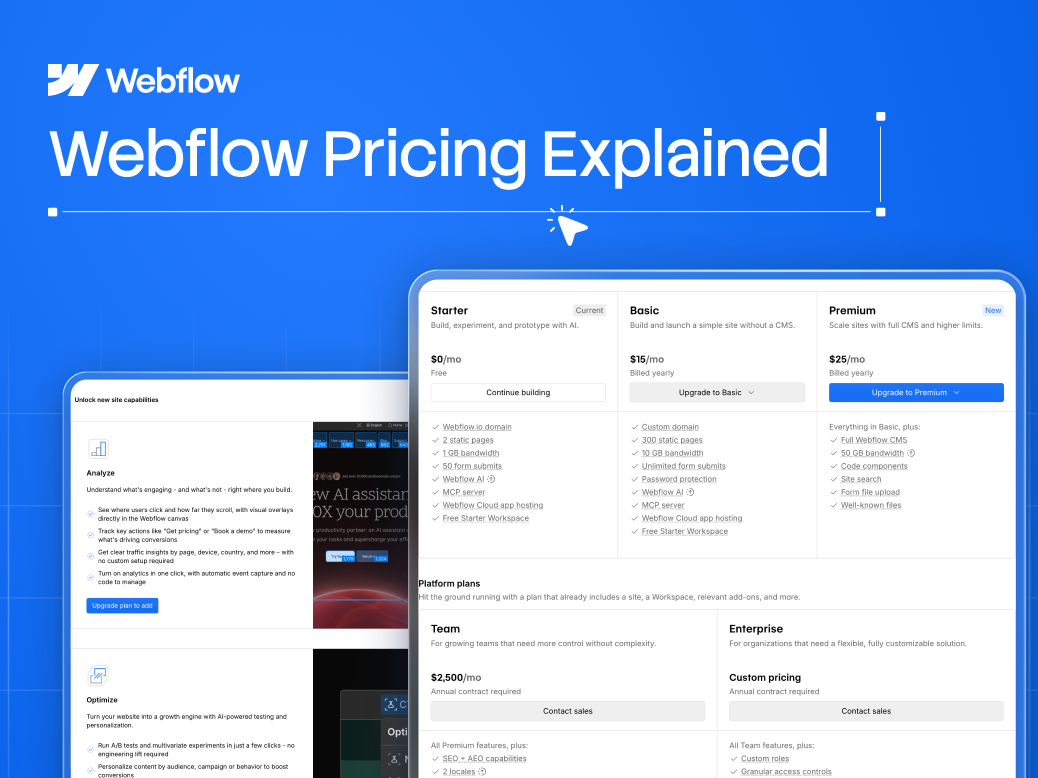
Webflow splits its cost into a Site plan (Basic ~$15/mo, Premium ~$25/mo annually) plus separate Workspace seats and usage-based add-ons, so a real B2B team often lands around $113–$128/month once seats are counted, and enterprise or agency workspaces climb well beyond that.
Wix wins on predictable, all-in-one entry pricing; Webflow costs more but scales more cleanly for teams that need multiple builders and serious performance.
Confirm current numbers on each platform's pricing page, since both adjust periodically. For a full breakdown, see our Webflow pricing guide. Winner: Wix on entry, Webflow on scale.
Webflow vs Wix at a Glance
| Factor | Webflow | Wix |
|---|---|---|
| Design control | Near-total, no templates needed | Template-first; Studio adds flexibility |
| SEO & Core Web Vitals | Clean static output, strong CWV | Improved but heavier, hybrid rendering |
| CMS & content scale | Built for structured content at scale | Fine for modest blogs |
| Ease of use | Steeper learning curve | Beginner-friendly, fast |
| Entry pricing | Site plan + seats + add-ons | All-in-one, lower entry |
| Best fit | B2B SaaS, scaling marketing sites | SMBs, local services, quick launches |
The Windmark Platform-Fit Test
Skip the debate and answer five questions. Each "Webflow" answer pushes you toward Webflow; mostly "Wix" answers mean Wix is genuinely the smarter, cheaper choice.
- Is organic search a primary growth channel? Yes → Webflow. No → Wix is fine.
- Will you publish content at scale (dozens+ of posts/case studies)? Yes → Webflow.
- Does your brand need to look category-leading, not templated? Yes → Webflow.
- Do you need it live in days with no design/dev help? Yes → Wix.
- Is your site mostly static with light updates and a tight budget? Yes → Wix.
If you answered Webflow to the first three, the platform choice is made, and the only real question left is whether you build it in-house or with a partner.
When Wix Is Actually the Right Call
We build on Webflow, and we'll still tell you the truth: Wix is the better pick for plenty of businesses. A local service company, a solo consultant, a small e-commerce shop, or an early founder validating an idea on a shoestring budget is genuinely better served by Wix's speed and all-in-one simplicity.
Choosing the "more powerful" platform you don't have the time or team to use isn't strategy. It's overkill. The right platform is the one that fits the job in front of you.
But if you're a funded B2B SaaS company where the website carries pipeline, SEO is a channel you can't afford to lose, and the brand needs to look like a leader. Webflow is the platform that still fits when you've scaled.
Making the Call
Webflow vs Wix isn't a fight one platform wins outright. It's a fit decision. If your website is a weekend project for a small business, Wix will serve you well and save you money.
If it's the growth engine for a B2B SaaS company that lives or dies on SEO, brand credibility, and content scale, Webflow is the platform built for that job.
If you've decided Webflow is the right fit but don't want to spend three months learning it, or you want it built right the first time, engineered to convert and rank, that's exactly what we do.
See Windmark's Webflow development service and our B2B Webflow build case study.. If you're a B2B team choosing your platform this quarter, we're built for exactly that.