
 ChatGPT
 Claude
 Gemini
 Perplexity AI
A founder forwarded us an ad last month: "Describe your business, get a full website in 60 seconds." He'd tried it.
The result looked fine in the demo and fell apart the moment he needed it to do a job, explain a nuanced product, rank for the terms his buyers search, and convince a skeptical VP to book a demo. "It's 80% there," he said. The problem, as always, is that the missing 20% is the entire point.
That's the real story of Webflow AI and B2B web design in 2026. The tools are genuinely impressive and genuinely useful, they've compressed weeks of production into hours. But there's a persistent gap between a site AI can generate and a site that actually moves pipeline.
This guide breaks down exactly what Webflow AI does today, where it's a superpower, where it still falls short for B2B, and how the best teams use it without outsourcing the decisions that matter.
Why AI in Web Design Matters for B2B Teams in 2026
The shift is real and it's fast. AI features are now baked into every major web platform, and the expectation from leadership has changed accordingly: "Why does a new landing page still take two weeks if AI can build a site in a minute?" That question is landing on marketing teams whether or not they have a good answer.
Here's the honest framing. AI has collapsed the cost of production, drafting, laying out, generating variations, close to zero. What it hasn't touched is the cost of judgment: deciding what to say, how to position against competitors, and which design actually earns a B2B buyer's trust.
And since Gartner reports buyers complete roughly 67% of their journey on your site before talking to sales, judgment is precisely what's at stake.
For B2B teams, that means AI is a leverage tool, not an autopilot. Used well, it lets a lean team ship like a much larger one. Used blindly, it produces a fast, generic site that looks like everyone else's, which, for a company trying to stand out, is its own kind of failure.
What Webflow AI Actually Does in 2026
Cutting through the hype, Webflow's AI capabilities cluster into three practical areas:
- Site and section generation. Webflow AI can scaffold layouts and sections from a prompt, giving you a structured starting point on the canvas instead of a blank page. It's a head start on production, not a finished design.
- AI-assisted content. Inside the Designer and CMS, AI helps draft and rewrite copy, generate alt text, and speed up the repetitive content work that used to eat hours. It's fastest at first drafts and metadata, not at final, on-brand messaging.
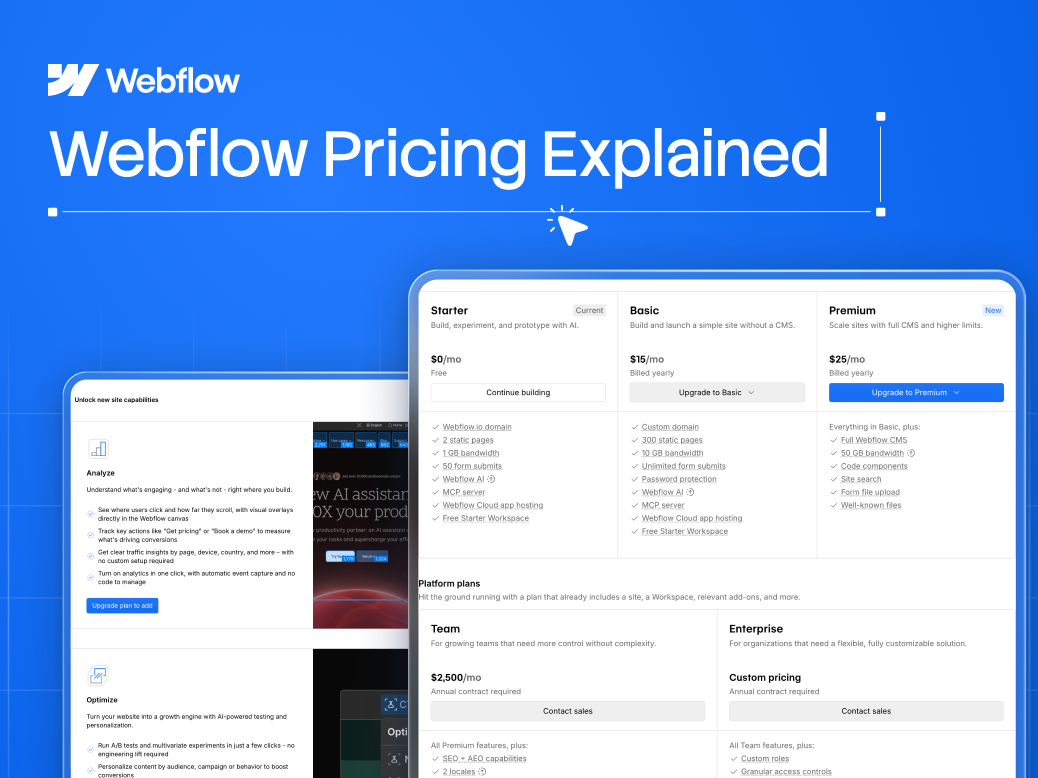
- AI-driven optimization. Through the Optimize add-on, Webflow offers AI-powered A/B testing and personalization, automatically serving variations and tailoring content to segments. This is where AI moves from "build faster" to "convert better," and it's the most strategically interesting layer for growth teams.
The through-line: Webflow AI accelerates the mechanical parts of building a site so your team spends its time on the parts that need a human. That's the right division of labor, and the teams getting value from it treat AI as a fast junior, not a senior strategist.
Where AI Genuinely Helps in a B2B Build
Be specific about the wins, because they're real. In our own builds, AI reliably earns its place in four spots: research (synthesizing competitor messaging and structuring content briefs), first drafts (rough copy and layout to react to, which is far faster than starting cold), the long tail of content (alt text, meta descriptions, CMS field population at scale), and QA (catching inconsistencies and accessibility gaps a tired human misses).
Notice what those have in common: they're all inputs and grunt work, not final decisions. AI turns a blank page into a rough draft in seconds, and a rough draft is dramatically easier to improve than nothing. For a lean B2B marketing team, that alone can double output, as long as someone senior owns what happens next.
Where AI Still Falls Short for B2B
The gap shows up wherever taste and stakes are involved. AI doesn't know your buyer's specific objection, why your last three deals stalled, or how to position against the competitor everyone secretly benchmarks against.
It generates the average of what it has seen, and average is exactly what a differentiated B2B brand can't afford.
It also can't make the conversion call. Which headline earns trust from a technical buyer versus a business one? Should the pricing page lead with value or transparency? These are judgment calls grounded in strategy and testing, and AI has no opinion worth trusting yet.
Left unsupervised, it produces sites that are competent and forgettable, the design equivalent of a form letter. For a five-page brochure that's fine. For the asset carrying two-thirds of your sales process, it isn't.
The Windmark AI-Assisted Webflow Workflow
Here's how we actually use AI on client builds, a human-in-the-loop method we call The Windmark AI-Assisted Webflow Workflow. The rule is simple: AI drafts, humans decide.
- Strategy (human). Positioning, messaging hierarchy, and conversion goals are set by people, before any generation happens. This is the 20% that determines everything.
- Draft (AI). We use AI to accelerate research, first-pass copy, and rough section scaffolding, getting to "something to react to" fast.
- Craft (human). Designers and copywriters shape the drafts into on-brand, conversion-focused work. This is where "generic" becomes "yours."
- Optimize (AI + human). Post-launch, we use AI-driven testing and personalization to improve what's live, with humans reading the results and forming the next hypothesis.
The point isn't to use AI more or less. It's to use it where it's strong and keep humans on the decisions that move revenue. See Windmark's Webflow development service and our B2B Webflow build case study.
Will AI Replace Web Designers?
The honest answer for 2026: not for serious B2B work. AI has automated production, not judgment, and B2B websites live and die on judgment. What's changing is the job itself.
The designer who uses AI to move faster, test more, and spend their time on strategy and craft will outproduce and out-earn the one who ignores it.
The threat isn't AI replacing designers; it's AI-fluent designers replacing AI-resistant ones. Curious how AI stacks up against Webflow as a standalone build method? We compare them directly in our guide on Webflow vs AI website builders.
Where to Start
If leadership is asking why your site still takes weeks when "AI does it in a minute," the answer isn't to defend the old pace. It's to adopt AI where it genuinely helps and protect the decisions that don't survive automation.
Start by letting AI draft your next landing page's first version, then measure how much faster your team gets to a shippable result.
If you're a B2B SaaS team that wants a site built with AI speed and human conversion judgment, not a fast, generic template, that's exactly how we work. Windmark's Webflow development service is built for exactly that.